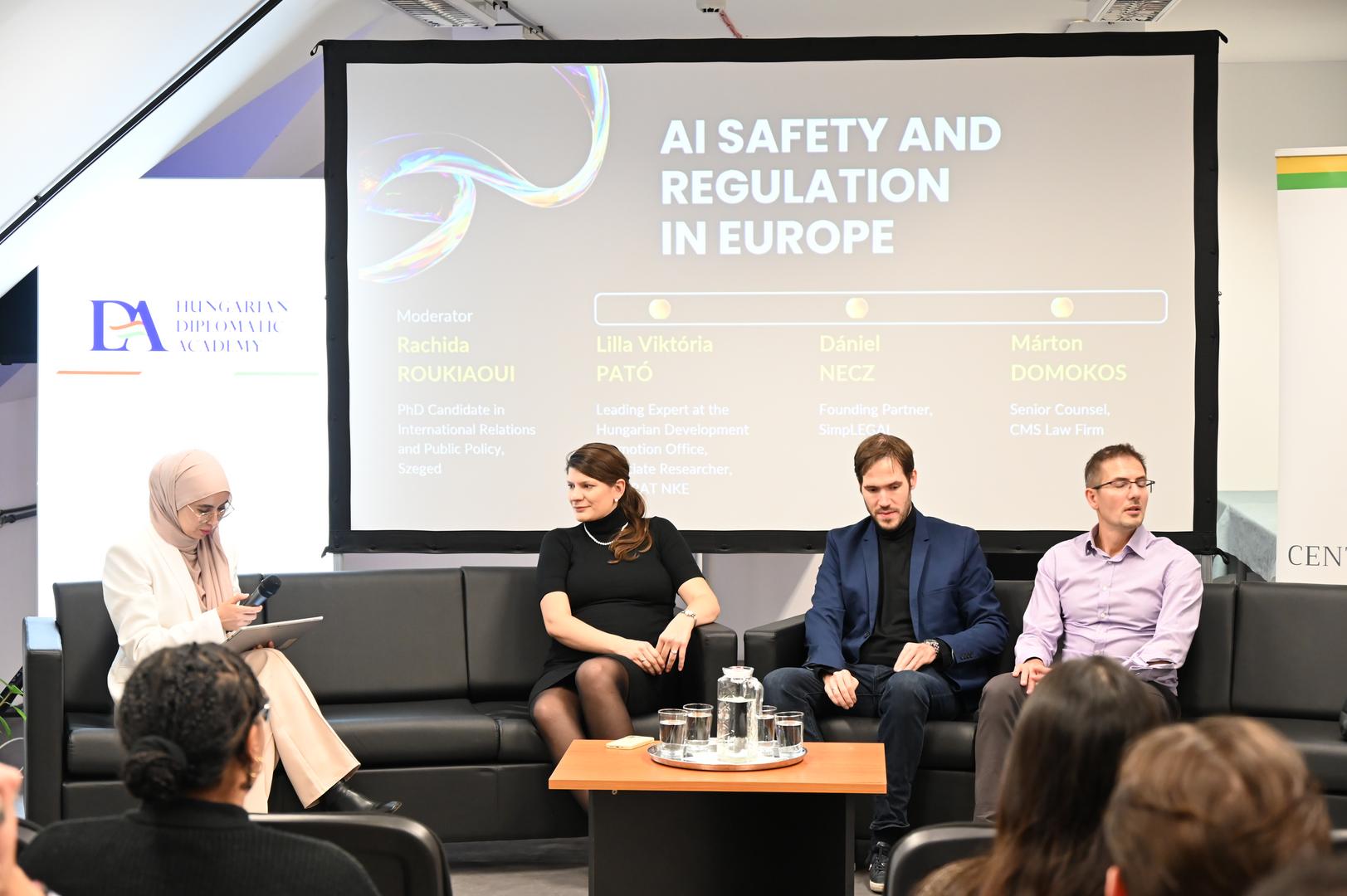
Viktória Lilla Pató, researcher at the Europe Strategy Research Institute, took part in an English-language roundtable discussion on 14 November 2025 at the invitation of the Central European Lawyers Initiative. The event focused on the global regulatory and technological competition surrounding artificial intelligence and featured Dániel Necz and Márton Domokos as fellow speakers, with Rachida Roukiaoui moderating the discussion.
Thanks to the active engagement of the audience – composed mainly of CELI mentees and Stipendium Hungaricum scholarship holders – the session quickly evolved into a dynamic professional debate. The participants explored the geopolitical, legal and economic implications of artificial intelligence, as well as the diverging strategic models shaping the global AI landscape.
The panel centred on the contrasting AI strategies of the EU, the United States and China.
The European Union remains committed to an “ethics-driven, regulation-first” model: through the risk-based AI Act and strong fundamental-rights safeguards, the EU aims to establish a reliable and predictable regulatory environment and shape global norms – the well-known Brussels effect.
The United States, by contrast, follows an “innovation-first” approach, driven by rapid experimentation, a flexible regulatory environment and the dominance of private investment.
China represents a hybrid path: a fast-scaling, enterprise-led AI ecosystem under strong state coordination, which provides enormous development capacity but raises significant transparency and legal concerns.
The discussion also touched on shifting global AI investment patterns. According to the latest State of AI 2025 report, the European Union has already attracted 8 billion USD in private AI investment this year—surpassing China—although it still lags far behind the United States. This reflects Europe’s gradual strengthening of its competitiveness pillar while maintaining its regulatory focus.

The roundtable was particularly timely, as Hungary brings its own Artificial Intelligence Act into force on 1 December 2025, while the European Commission has just proposed a new Digital Package aimed at simplifying digital rules and boosting innovation. As emphasised by our researcher during the discussion, both the Hungarian and European models can become competitive alternatives only if strong domestic innovation capacities accompany the regulatory framework.
This idea is explored in greater depth in Viktória Lilla Pató’s analysis, “Three Paths to AI: Competition, Control, Coordination”, which examines the United States’ rapid market-driven model, China’s state-coordinated ecosystem, and the EU’s deliberately constructed “third way”. The article highlights the key dilemmas facing Hungary as it positions itself within the emerging European AI architecture.
The analysis is available at Ludovika blog: https://www.ludovika.hu/en/blogs/the-daily-european/2025/12/01/three-paths-to-ai-competition-control-coordination/